Choose a footed colander first for routine pasta draining and vegetable rinsing; choose a fine-mesh strainer first if you also want to sift dry ingredients. There is overlap: OXO lists pasta and vegetables among the uses for both its stainless steel colander and fine-mesh strainer, while King Arthur confirms that fine mesh can sift flour, cocoa, and confectioners’ sugar. The better purchase depends on your batches, support needs, and smallest ingredients—not simply the name on the package.
Start with what you need to retain
Before comparing materials or matching sets, write down your three most common jobs. Separate bulk draining from small-ingredient work, and note whether you want to keep the food in the basket or collect what passes through it.
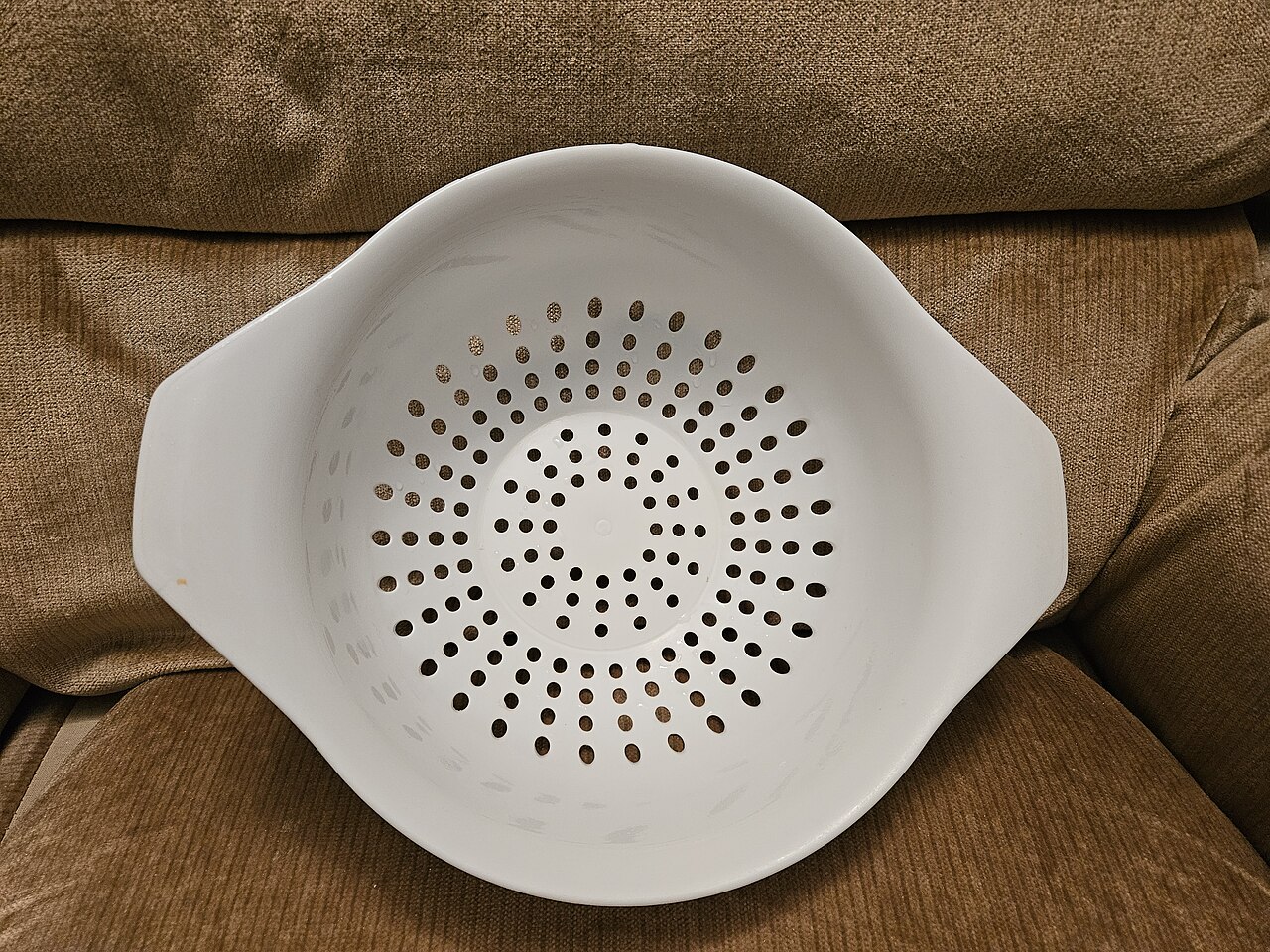
For pasta and vegetables, a conventional perforated colander is a sensible starting point. OXO’s 3-quart model has elevated handles and three feet, with perforations intended for quick drainage. Those are useful features to look for when your priority is a freestanding basket rather than a tool supported over a bowl. OXO colander details
For baking, fine mesh adds a different capability: separating lumps from dry ingredients. King Arthur explains that a fine-mesh strainer can perform the sifting work of a dedicated sifter. If occasional sifting is your only unmet need, consider a strainer before adding a single-purpose baking tool. That does not mean every batch of flour needs sifting; King Arthur says it is unnecessary for many modern baking tasks. King Arthur’s sifting guidance
Treat rice and tiny grains as a separate buying question
Do not assume that anything called a colander is unsuitable for grains—or that anything called fine mesh will retain every small ingredient.
OXO’s Rice & Grains Washing Colander is an important exception to the usual category shorthand. Its small square holes help retain grains, and its drainage is deliberately slow enough for water to pool. The manufacturer specifically names rice, quinoa, buckwheat, and barley. OXO grain-colander details
That makes it worth considering if grain washing dominates your routine. The tradeoff is purpose: a design intended to hold water briefly is not pursuing the same quick-draining behavior as a general pasta colander. Choose according to the job rather than treating faster drainage as automatically better. OXO grain-washing design
The cited OXO fine-mesh strainer page does not provide an aperture measurement or explicitly confirm quinoa retention. For tiny grains, ask for confirmation about the exact ingredient rather than relying on a close-up photograph or the words “fine mesh.” OXO strainer specifications
Decide how the tool will be supported
A useful distinction is whether you want the basket to stand independently or rest across another vessel. OXO’s colander has feet, while its handled fine-mesh strainer has a small loop intended to rest on a pot or bowl. Colander support · Strainer support
For a bowl-resting design, measure your intended bowl’s opening and ask whether the handle-side support and opposite loop will both reach its rim. Check basket depth as well: you want a workable arrangement, not merely a diameter that sounds compatible. Do not read “rests on bowls” as a promise that it fits every bowl.
For a freestanding design, prioritize a manageable loaded size and accessible handles. If possible, compare the handle space with a tool you already find comfortable rather than judging grip from a product photograph.
Measure storage, not just the basket
A nominal basket size can disguise the space taken up by the handle. For example, OXO lists its 6-inch strainer at 14 inches overall in one dimension. Check the complete dimensions against your drawer or hanging space before ordering. OXO strainer dimensions
Nesting claims also deserve a compatibility check. OXO says its colander nests in its own stainless steel mixing bowls; that is not confirmation that it will nest neatly in your existing set. OXO nesting information
A practical pre-order checklist
- Name the smallest ingredient you expect the tool to retain; request confirmation if the listing is vague.
- Choose your usual batch, not an occasional oversized one, as the starting point for capacity.
- Measure the receiving bowl, sink space, and storage location separately.
- Confirm whether support comes from feet, a rim, or a handle-and-loop arrangement.
- Read the exact model’s care information before buying; do not infer it from material alone.
My buying recommendation: start with whichever design solves your most frequent task. Add the other only when you can name a recurring job the first does awkwardly. A complementary pair can be useful, but an unnecessary set is still unnecessary.