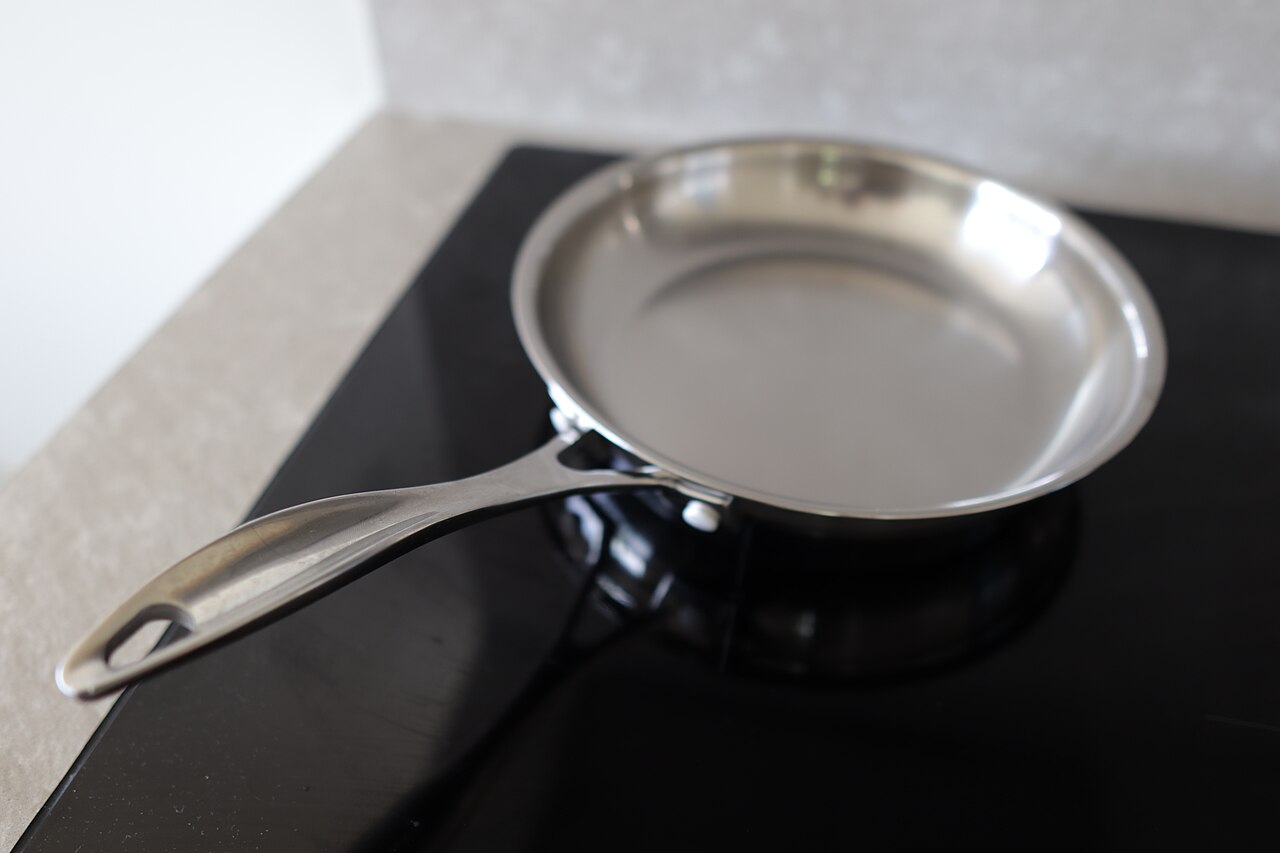
Start with a magnet—but keep checking
Before replacing your cookware, start with a simple screening test: hold a magnet against the underside of each pan. All-Clad identifies a magnetic bottom as a sign of induction compatibility and recommends matching the pan’s base closely to the burner size. All-Clad compatibility FAQ
Treat that result as the beginning of your check, not a guarantee for every cooking zone. Lodge explains that a pan that is too small for a particular induction burner may not trigger heating. The practical conclusion: check the pan and appliance together. Lodge induction guidance
A useful way to organize the job is to make four separate checks: material, base construction, base size, and appliance requirements.
Check 1: Look beyond the material name
The important question is whether the pan has a magnetic base—not simply whether its description says stainless steel, aluminum, or nonstick. All-Clad identifies magnetic stainless steel, cast iron, and enameled cast iron as suitable materials. Aluminum, copper, and glass without a magnetic layer do not meet that requirement. All-Clad induction guide
An aluminum body does not automatically rule a pan out. For example, All-Clad’s NS Pro three-piece fry-pan set combines aluminum construction with a stainless steel induction base, and the manufacturer explicitly lists induction compatibility. That is a construction-specific example, not a promise about every aluminum or nonstick pan. NS Pro product specifications
For your own inventory, write down the brand, collection, and model number where available. Use those details to find the exact product documentation rather than relying on appearance.
Check 2: Inspect and identify the base
Apply the magnet to the bottom, rather than using attraction to a handle or lid as evidence. All-Clad’s test specifically concerns the pan’s underside. If the result is unclear, put that piece in a “needs confirmation” group instead of guessing. All-Clad compatibility FAQ
Base shape also deserves attention. All-Clad recommends flat, sturdy bases. However, Lodge explains that a designed heat ring can leave a small gap without preventing induction operation. These statements should not be collapsed into a universal rule that every base must touch the glass everywhere. Check unusual designs against the exact cookware and appliance manuals. All-Clad base guidance and Lodge heat-ring guidance
Check 3: Record the base size separately
Measure and record the underside diameter, then compare it with the cookware dimensions requested in your appliance manual. Keep the base measurement separate from the pan’s advertised size; the comparison you need is the one your appliance manufacturer specifies.
All-Clad recommends choosing a base close in size to the burner. Lodge adds an important qualification: an undersized pan may not be detected, and requirements differ between cooktops. Neither source establishes one minimum diameter that applies to every appliance. All-Clad sizing guidance and Lodge pan-detection guidance
Check 4: Match the exact pan to the exact appliance
Use this checklist while reviewing documentation:
- Material: Does the cookware manufacturer explicitly identify this item as induction compatible?
- Base: Does the magnet test agree with that description?
- Size: Have you recorded the base diameter and compared it with the selected zone’s requirements?
- Appliance: Have you checked the exact model’s cookware-selection section?
- Exceptions: Have you checked the individual piece rather than assuming the whole collection qualifies?
That last question matters. All-Clad’s NS Pro page lists induction-compatible fry pans but also identifies collection exceptions, including certain griddles, grills, a crepe pan, and a roaster. A collection name alone is therefore insufficient evidence. NS Pro compatibility exceptions
Before shopping, sort your inventory into “documented match,” “needs confirmation,” and “replacement candidate.” Prioritize resolving uncertainty about the pieces you use most. Refer to your exact product manuals for operating and care instructions.
Know the limits of a screening check
These manufacturer sources explain general cookware screening. They do not establish a match between your individual pan and cooktop. Confirm model-specific base dimensions and cookware requirements in your exact appliance and cookware documentation before deciding what to keep or replace.