Start with the shelf, not the matching set
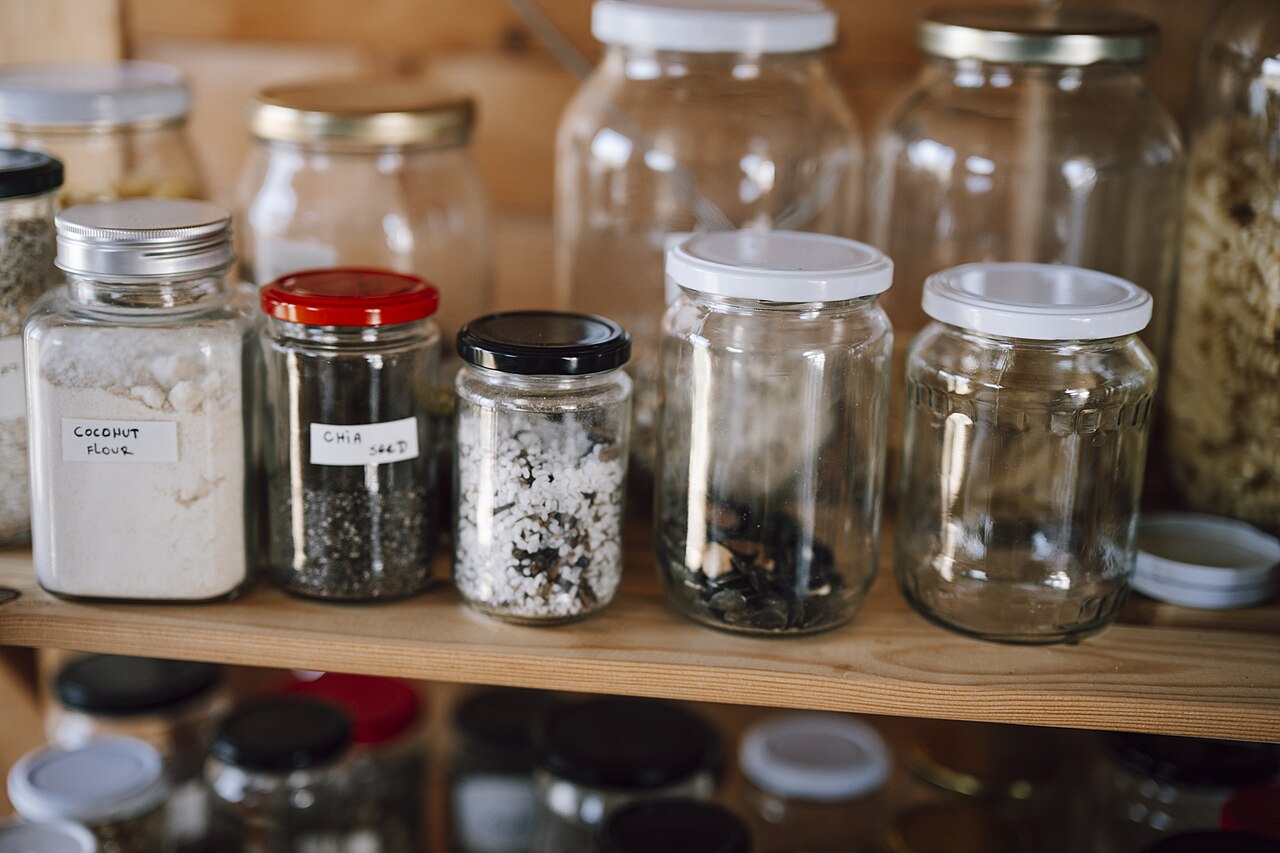
Before choosing pantry containers, measure where they will live and decide how you want to use them. For each staple, ask: Will I scoop from the container on the shelf, or pull it out and open it on the counter?
Use three separate checks: storage fit, removal clearance, and opening space. Treat a container that passes only the first check as a candidate—not a finished purchase decision.
Measure the usable space
Empty one shelf and record its narrowest usable width, depth, and height. Measure around hinges, shelf supports, and door-mounted storage rather than assuming the entire shelf is available. Check the opening through which you will remove the container, too.
For depth, measure from the back to the front boundary you want containers to stay behind. With cabinet doors, check the space available when they are closed. For height, measure to the lowest obstruction above the intended position.
Try a paper footprint before ordering. Cut a rectangle matching the candidate’s listed dimensions, place it on the shelf, and check alternative orientations. Reserve some space for your hand rather than planning an edge-to-edge arrangement.
Compare exterior dimensions, not just quarts
OXO lists its Big Square Medium POP container at 6.25 × 6.3 × 9.9 inches, with a capacity of 4.4 quarts. These are separate specifications: use the product dimensions for shelf planning and the capacity for comparing storage volume. OXO Big Square Medium specifications
For comparison, OXO’s Rectangle Medium listing gives dimensions of 6.25 × 4.15 × 9.9 inches and a 2.7-quart capacity. Its narrower footprint offers a different layout option despite the same listed height. OXO Rectangle Medium and Big Square Medium specifications
As a planning example, placing two Big Square Medium containers front-to-back with their 6.3-inch sides along the shelf depth requires 12.6 inches before any handling allowance. That arrangement would not fit within a 12-inch usable depth. This calculation uses OXO’s listed dimensions, not a physical fit test. OXO dimensions
When a listing leaves dimension orientation unclear, confirm it with the manufacturer. Ask for the maximum exterior dimensions with the lid fitted, including protruding parts, before committing to a tight layout.
Shelf-depth and opening-clearance worksheet
Copy this worksheet for each shelf and candidate. Keep all measurements in the same unit.
- Shelf location: ______
- Usable width at the narrowest point: ______
- Usable depth with doors closed: ______
- Clear height beneath the lowest obstruction: ______
- Doorway or cabinet opening, width × height: ______
- Exact container model and size: ______
- Maximum exterior width × depth × closed height: ______
- Planned orientation and number of rows: ______
- Depth remaining: usable depth minus total container depth = ______
- Overhead space: clear height minus closed container height = ______
- Extra space needed to operate and remove the lid: ______
- Intended use: open on shelf / remove to counter
- Hand access and unobstructed removal confirmed: ______
Do not treat the overhead-space result as proof that the lid will open. OXO describes a top button used to release and remove its POP lid, but the cited product specifications do not quantify the additional operating clearance. Confirm that space with the exact product or ask the manufacturer; there is no supported universal allowance here. OXO lid description and specifications
For product operation and care, consult your exact model’s manual.
Check capacity without promising a whole bag will fit
Manufacturer bag-size guidance can help narrow a shortlist. For example, OXO describes the two 4.4-quart containers in its prelabeled flour-and-sugar set as sized for a standard 5-pound bag of flour or sugar. Keep that claim attached to those products and ingredients, rather than extending it to every 4.4-quart container or pantry staple. OXO prelabeled set
Weight alone does not establish a universal container size. King Arthur’s chart lists one cup of all-purpose flour at 120 grams and one cup of granulated white sugar at 198 grams. That difference illustrates why equal-weight packages need not occupy equal volumes; it does not establish guaranteed bag-to-container fit. King Arthur ingredient weight chart
For your shopping notes, record the ingredient, usual package quantity, and whether you want room for a scoop or leftovers from the previous package. If capacity remains uncertain, buy one candidate before duplicating it.
Buy for your routine
Start with containers for the staples you reach for most often. Favor a single accessible row if you dislike moving items to reach the back. Before choosing stacked storage, decide whether unstacking fits your routine.
Use a matching set only after assigning each size a shelf position and a job. The goal is not to fill every inch—it is to make ingredients easy to reach, remove, and put away.