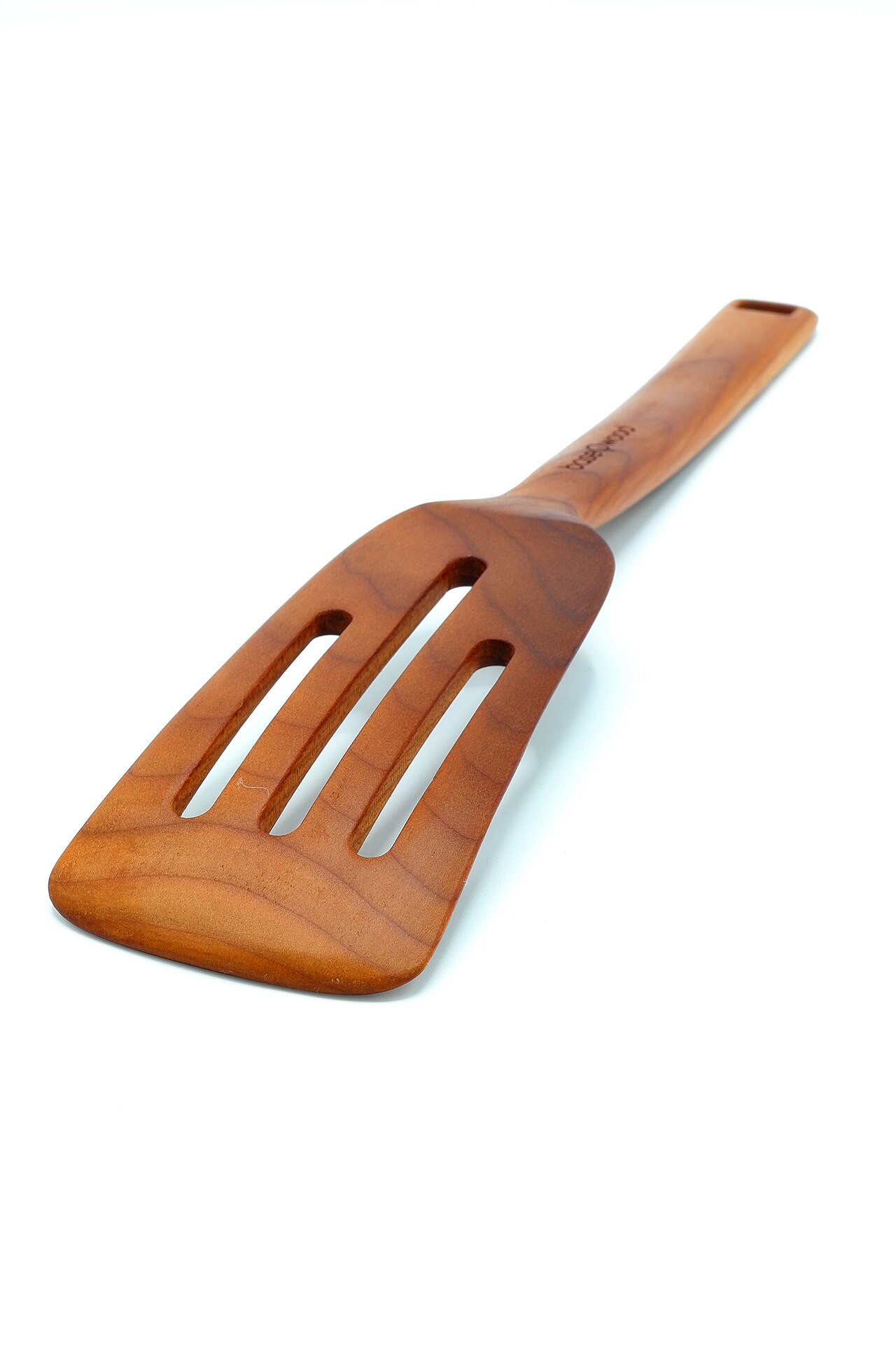
Choose wood if you prefer a solid, one-piece stirring tool and accept hand-wash-only care; choose a flexible-edged silicone design when scraping is the priority. For example, those differences appear in OXO’s Wooden Corner Spoon and Silicone Everyday Spatula. You need not choose one material for the entire drawer: start with the task your current utensils handle poorly.
Buy the working edge, not just the material
For stirring along pan walls and reaching corners, consider a wooden spoon with a deliberately shaped edge. OXO’s Wooden Corner Spoon uses solid, one-piece beechwood and a straight-sided profile intended to reach cookware walls and corners. OXO also identifies it as suitable for nonstick cookware. That makes this particular design worth considering if corner access matters more than a flexible scraping edge. OXO Wooden Corner Spoon
For scraping bowls and pots, look for explicit information about edge flexibility. OXO’s Silicone Everyday Spatula has flexible, beveled edges and a handle reinforced with a nylon core. My buying recommendation is to distinguish a yielding edge from a yielding handle: look for the flexibility you need at the food-contact edge without assuming the entire utensil should bend. OXO Silicone Everyday Spatula
For lifting and flipping, compare turners rather than treating a stirring spatula as interchangeable. OXO’s Silicone Small Flexible Turner has a silicone-covered metal core, beveled edges, and an angled neck intended to clear pan sides. It illustrates why head shape and reinforcement deserve as much attention as the word “silicone.” OXO Silicone Small Flexible Turner
Read the construction details from head to handle
A silicone utensil is not necessarily silicone throughout. The examples above use different internal supports. OXO’s Steel Silicone Cooking Spoon offers another construction: a silicone working end with a stainless-steel structure and a grip section designed to reduce slipping. OXO describes it as a tool for both stirring and serving. Consider the spoon shape when you want to portion food as well as move it around a pan; compare the handle and head with the wooden option before ordering. OXO Steel Silicone Cooking Spoon
Before ordering, inspect photographs of the handle-to-head transition and read the materials description. Ask whether the head is fixed or removable if the listing leaves that unclear. Do not infer a seamless construction, replaceable head, or particular internal reinforcement from a front-facing photograph.
These product pages establish construction and intended uses, not comparative lifespan. They do not provide enough evidence to declare that wood always lasts longer, or that silicone always performs better.
Let cleanup requirements narrow the shortlist
Use the stated care category as a buying filter, rather than relying on the material name. OXO labels its wooden corner spoon hand-wash-only, while its everyday silicone spatula is dishwasher-safe. If dishwasher compatibility is nonnegotiable, that distinction can settle this particular comparison before you consider appearance. Wooden spoon care classification and silicone spatula care classification
Check the care instructions for the complete utensil, including its handle. OXO lists the Steel Silicone Cooking Spoon as dishwasher safe. That gives it a different stated cleaning routine from the hand-wash wooden spoon discussed above. Do not apply that care claim to every mixed-material utensil; use the instructions for the exact model. OXO spoon care information
Check fit and permissions before ordering
Use this checklist on each candidate, including individual pieces within a set:
- Name its main job: stirring, scraping, lifting, or serving. Avoid buying several tools without a distinct role for each.
- Compare the listed overall length with a utensil you already find comfortable. Check drawer clearance as well as pot reach.
- Ask for head dimensions if only overall dimensions are provided. Compare the proposed head with your smallest frequently used pan.
- Look at the edge profile and neck angle. For example, OXO explicitly connects its small turner’s beveled edge with lifting and its angled neck with pan clearance. OXO turner design details
- Confirm compatibility with your cookware and read the exact utensil’s heat-use instructions. Ask the manufacturer about any intended use the listing does not address.
- Record the care classification for the complete tool, including its handle.
A useful starting point
My recommendation is to buy one tool for the biggest gap in your drawer, then reassess. Choose a shaped wooden spoon for the stirring role, a flexible-edged silicone spatula for scraping, or a purpose-built turner for lifting. A mixed collection is perfectly reasonable; matching materials are less important than matching each tool to a real job.